Frontier Severance
Systema Delenda EstFrontier Severance is the emergency act by which Misse Eln cuts the System’s frontier away from the uncontaminated Core. It is both a strategic response to Cato’s campaign and a seizure of supreme authority: with the title of True Deity behind her, Misse transforms a defense crisis into a new political order, accepting the abandonment of millions in order to preserve the System and rebuild it under her control.
Causes and Background
The decision follows the celebration of a world’s induction into the Core, where Misse Eln is pulled away by alerts reporting Cato’s presence across numerous worlds controlled by the remaining independent gods. Her expanded access as True Deity lets her see what ordinary officials cannot: the invasions are not merely causing territorial losses. The System is pouring essence into damaged worlds to compensate for the destruction of their infrastructure, turning every compromised frontier world into an ongoing expense.
This reveals the logic behind Cato’s otherwise puzzling conduct. He has not relied on a single spectacular assault. Instead, he has opened many separate wounds, conquered worlds, and then remained quiet enough to keep the damage from immediately appearing decisive. Misse recognizes the pattern as a war of attrition operating across thousands of worlds. The frontier is therefore dangerous not only because Cato occupies it, but because the System itself continues investing essence in places he has already compromised, allowing him to weaken the System while expanding his own power.
Misse concludes that continued defense is unsustainable. The frontier provides little value compared with the Core and Inner Worlds, while each moment of continued connection permits further losses. Her proposed answer is not to reclaim every world but to sever the frontier, stop the flow of essence, and prevent Cato from turning the damaged territories into weapons against the System.
Misse Eln’s Emergency Authority
The severance becomes possible because Misse Eln has claimed the status of True Deity. In the True Core, she has access to the full range of the True Interface, including functions unavailable to ordinary World Deities. Her authority is effectively uncontestable within the System, and she shares access with Muar, whose loyalty is directed toward the System itself and toward Misse as its most worthy representative.
Misse summons the heads of the Nine Great Clans to the celebration and presents the crisis as a grave duty chosen by the System. She insists that the System, rather than clan interests, must become the focus of political effort. When a clan leader objects, she suppresses his voice with a gesture; when another challenges her right to decide, she silences him as well. These demonstrations do not merely end interruptions. They establish that the ordinary balance of clan agreements and territorial claims has been suspended by a higher emergency authority.
Her language combines administrative calculation with religious legitimacy. Cato is described as having compromised essentially the entire frontier and as stealing essence while destroying the worlds that contain it. Misse frames severance as the only practical cure for an infection that cannot be removed by conventional means. The frontier is no longer treated as a collection of communities with equal standing, but as expendable material whose continued connection threatens the sacred center.
The Course of the Severance
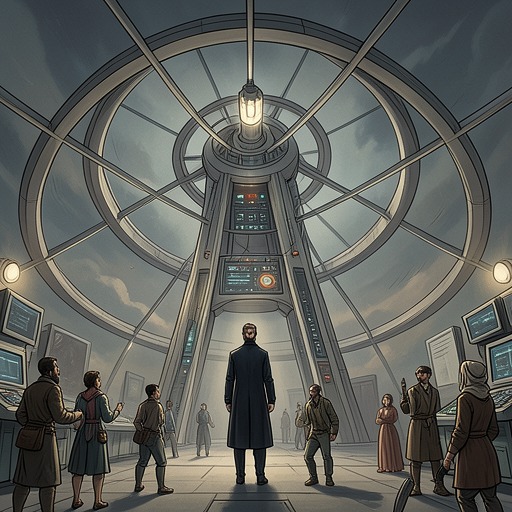
Misse projects the System as a vast wheel of worlds and essence flows, then uses the True Interface to detach every Deity from the worlds assigned to them and reconnect them to the Core Worlds. The operation would have been impossible under lesser ranks. By exercising her new authority, she removes the old administrative geography in a single act and concentrates divine power around the Core.
She next creates a lower-essence preserve on War World Lek. One-way portals are opened from the frontier to that preserve, and quests are assigned to frontier populations instructing them to leave. Misse doubts that many people will accept the route, but she regards it as a way to retain those who remain genuinely faithful to the System. The evacuation is therefore not presented as a universal rescue. It is a selective passage shaped by faith, access, and willingness to abandon established homes.
The severance is broadcast through the System map so that every Deity can see the change. Misse calls the withdrawal temporary and portrays the frontier as dead weight that can be replaced by new, better worlds. Yet the procedure is also plainly punitive. Once the frontier worlds are cut off, they may survive only briefly without the Core’s support. If Cato appears in any of them, Misse intends to expunge the world rather than continue investing essence in it, accepting the destruction of its inhabitants as preferable to allowing further losses.
Consequences and Aftermath
Frontier Severance changes the meaning of defense within the System. Previously, damaged worlds remained connected because the System attempted to preserve their infrastructure and continuity. Misse reverses that priority: preserving the System’s essence takes precedence over preserving every population under its authority. The people of the frontier become the cost of maintaining the Core, even though Muar explicitly objects that millions of them do not deserve abandonment.
Muar’s objection exposes the event’s central moral conflict. He accepts that the worlds may already be too compromised to save, but he refuses to treat their inhabitants as equivalent to wasted resources. Misse agrees that the people do not deserve abandonment and promises that as many as possible can be moved into the Inner Worlds and Core. Nevertheless, she insists that the operation must happen immediately, before the compromised worlds can be turned against the System. Compassion survives in her reasoning only as an evacuation program subordinate to strategic necessity.
The event also consolidates Misse’s transformation from a newly elevated administrator into an active sovereign. She does not merely respond to a crisis inherited from Cato’s campaign; she uses the crisis to reorganize the System, detach its gods, centralize authority, and define which worlds count as salvageable. Her final claim is that it is time to build a better System according to her design. The frontier’s destruction is therefore both a defensive retreat and the founding gesture of a new regime.
Narrative Significance
The severance gives institutional form to the System’s theology of belonging. Muar experiences the System as purpose, truth, and meaning after his terrifying exposure to System-less existence; Misse turns that same system of meaning into a mechanism for deciding who may remain inside its protection. Her action stands in sharp contrast to Cato’s stated grievance, which is directed against the System rather than its people. Cato seeks to expose or destroy the structure while preserving its inhabitants; Misse seeks to preserve the structure by isolating, evacuating, or eliminating the worlds that threaten it.
The event also foreshadows the larger collapse of the System’s governing order. Its apparent unity depends on portals, essence flows, divine assignments, and the willingness of local populations to accept the System’s definition of reality. Once Misse can detach deities and worlds at will, connection itself becomes a privilege granted by sovereign power rather than a stable condition. Frontier Severance thus converts geography into judgment: the Core is declared pure, the frontier condemned as contaminated, and the boundary between salvation and abandonment placed in the hands of one True Deity.